
Open Licenses / CC Licenses
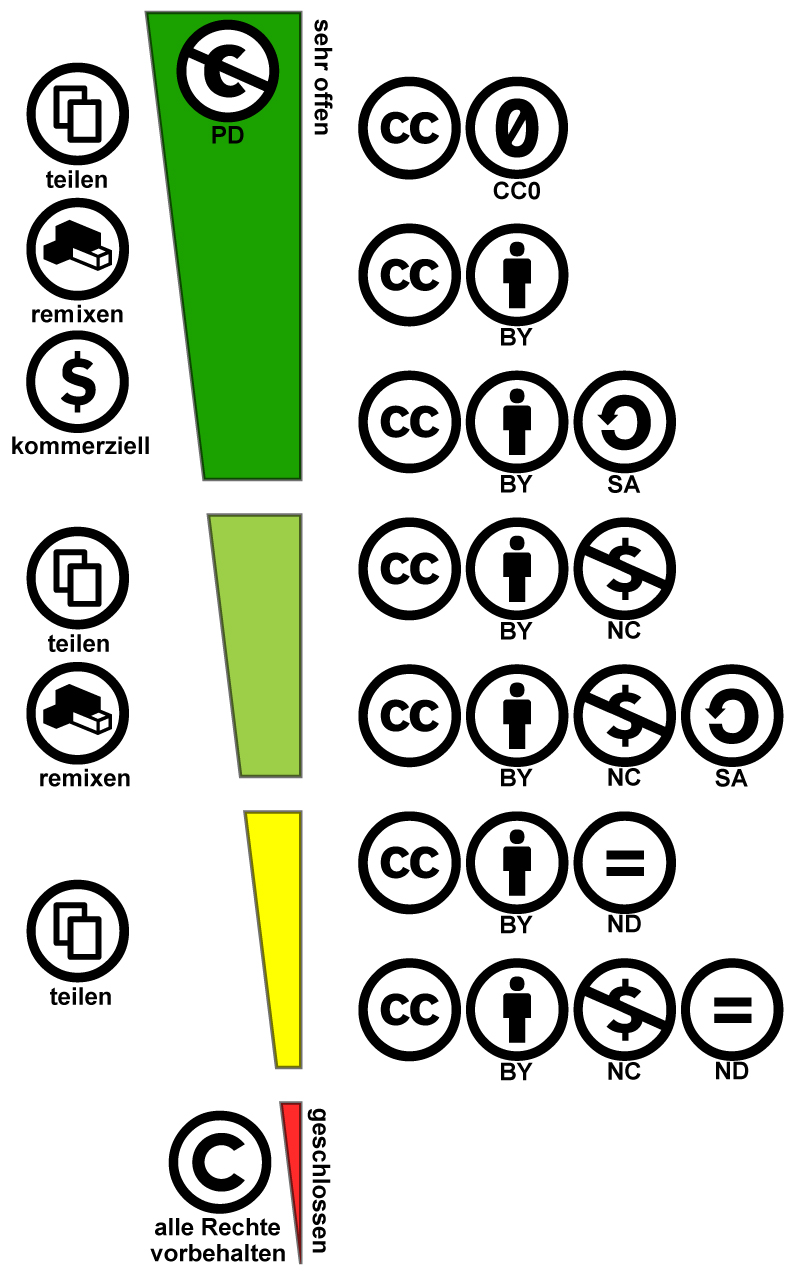
An open (or free) license for a publication allows for open use, in which usage rights are defined and granted through licensing. These open licenses are standardized and internationally recognized usage rights that precisely specify how the publication may be used.
The various Creative Commons licenses (CC licenses) help rights holders align the rights to their content with their own ideas and needs, such as the requirement to attribute the author.
As an author, you can specify how your publication may be distributed and used, thereby granting more rights than those provided for by copyright law. Granting a free license for a publication thus makes it clear to everyone how the publication may be used and provides greater legal certainty—both for authors and for those who reuse the content. For open-access publications in particular, this not only ensures optimal accessibility, visibility, and dissemination but also clearly defines the legal framework for the reuse of the research results contained in the publication.
If, as an author, you wish not only to disseminate and make your publication accessible but also to permit its use or reuse, KIT Library recommends, in accordance with the German Research Foundation (DFG), granting an open license for the publication.
Creative Commons licenses have gained international recognition and acceptance, not only in the academic field. Based on a modular approach, a total of six different variants of an open CC license can be created using four license modules or types.
Overview of CC License Variants
- CC0: With this license, you waive your copyrights to the extent permitted by law.
- CC BY: With this license, you allow third parties to distribute and modify your work, even for commercial purposes, as long as the authors of the original are credited.
- CC BY-SA: With this license, you allow third parties to distribute and modify your work, even for commercial purposes, as long as the creators of the original are credited and any new works based on your work are published under the same terms.
- CC BY-ND: Under this license, you allow third parties to redistribute the work, including for commercial purposes, as long as it is done without modifications, in its entirety, and the original authors are credited.
- CC BY-NC: Same as CC BY, but with the restriction that redistribution must be non-commercial.
- CC BY-NC-SA: Same as CC BY-SA, but with the restriction that redistribution must be non-commercial.
- CC BY-NC-ND: Same as CC BY ND, but with the restriction that no commercial use is permitted.
Detailed explanations of the CC licensing model can be found on the official Creative Commons website.
In addition, there are other open licenses, such as the GNU Free Documentation License (GFDL) for software or the Open Database License (ODbL) for research data.
Choosing a Creative Commons License
If you’d like to assign a CC license to your publication, consider what’s most important to you—for example, the widest possible distribution, extensive reuse, or protection against commercial use. There’s often a tendency to exclude commercial use. Keep in mind, however, that this also means your work cannot be used in non-commercial contexts if a more permissive license is applied there (e.g., on Wikipedia, where the CC BY-SA license is the standard). Similarly, your work cannot be used on academic blogs if they contain advertising.
Only the CC BY and CC BY-SA licenses are considered open, Open Access-compatible CC licenses. The “Non-Commercial” license types (CC BY-NC, CC BY-NC-SA, CC BY-NC-ND) hinders reuse and redistribution. Due to the unclear definition of “commercial,” this licensing leads to many uncertainties and difficulties in drawing clear boundaries, thereby complicating the ability to reuse the content.
"Choose a License for Your Work" helps you find and select the right CC license.
Further information
- Till Kreutzer: “Open Content – Ein Praxisleitfaden zur Nutzung von Creative-Commons-Lizenzen”
- Creative Commons FAQs
How do I license my publication?
Choose a license and include the corresponding license text in your publication (usually on the back of the title page). For secondary publication (e.g., if you have already published with a publisher and now want to make your publication available in the KITopen repository as well), please review your publishing contract: You may only assign a license that is compatible with that contract. Take this into account as early as possible—ideally when deciding where you would like to publish—and negotiate with the publishers.
- Include the license text in your publication on the back of the title page (templates are available for all CC licenses).
- Specify the selected license in KITopen. If you notify us of your publication via email, please specify the selected license in your email. If you are adding your publication to KITopen yourself during data recording, please specify the selected license in the “Comments on the Publication” field. General information on publishing in KITopen can be found on the corresponding webpage.
Urheberrecht, Autorenrechte und Lizenzen
Beratung und Unterstützung zum Urheberrecht und der Anwendung des Urheberrechtsgesetzes (UrhG)
Telefonisch unter +49 721 608-43106 oder per E-Mail an: linda sefrin∂kit edu
Beratung und Unterstützung zu Autorenrechten und (offenen) Lizenzen
Telefonisch unter +49 721 608-43128 oder per E-Mail an: tomislav jersek∂kit edu

Data Protection and Law, academic internship, TEAM RDM@KIT
 +49 721 608-43106
 linda sefrin ∂does-not-exist.kit edu
 434
434 30.50 Campus Süd
