
Open Educational Resources at KIT
KIT is convinced that the use, creation, and publication of Open Educational Resources (OER) are fully aligned with its values and mission of creating and disseminating knowledge for society. For this reason, KIT adopted an OER Policy in 2021.
General Information
“Open Educational Resources (OER) are educational materials of any kind and in any medium that are made available under an open license. Such a license enables free access as well as the free use, adaptation, and redistribution of these materials by others, with no or only minor restrictions. The creators themselves determine which rights of use they grant and which rights they reserve.” Source: Deutsche UNESCO-Kommission; translated by KIT-Library
KIT is convinced that the use, creation, and publication of OER are fully aligned with its values and mission of creating and disseminating knowledge for society. For this reason, KIT adopted an OER Policy in 2021:
“Open Educational Resources (OER) are educational materials of any kind and in any medium that are made available under an open license. Such a license enables free access as well as the free use, adaptation, and redistribution of these materials by others, with no or only minor restrictions. The creators themselves determine which rights of use they grant and which rights they reserve.” (1)
KIT is committed to maintaining and continuously enhancing the high quality of teaching and learning. The strategic documents addressing the IV topics related to teaching and studies emphasize the use of modern teaching and learning methods as well as the integration of digital elements into education. The use of OER can contribute to these goals by reducing the effort required to create teaching and learning materials, as existing resources can be adapted and reused. In addition, the costs associated with licensing educational materials can be avoided.
The possibility of adapting and further developing educational resources to meet specific teaching and learning objectives and the needs of particular target groups results in tailored, high-quality educational materials and thus provides significant benefits for teaching and learning at KIT. By creating and publishing OER, KIT actively contributes to a thriving OER community and to a continuously growing pool of educational resources. This is based on the conviction that the use, creation, and publication of OER are fully aligned with KIT’s values and mission of creating and disseminating knowledge for society.
Against this background, the present recommendations complement the existing regulations on Open Access and scientific publishing (2) at KIT, as well as those on research data management (3) by addressing the specific aspects of working with open educational resources.
KIT encourages its staff and students to use, create, and publish Open Educational Resources (OER).
- When using third-party OERs in one’s own teaching, the responsibility for quality control of the materials used lies with the respective instructor. Both staff and students must comply with the terms of use specified in the respective license.
- When producing OER, it is the creator’s responsibility to ensure that he or she has the necessary rights to license and publish an OER, as well as to comply with the rules of good research practice (4) are observed.
- OER should be published using the KIT URL format (5) and be released under a license that is as open and unrestricted as possible (preferably CC BY or CC BY-SA) in order to promote the dissemination and collaborative further development of OER.
- The OERs are to be published via KIT’s relevant platforms. Additional nationwide distribution channels (e.g., social media, the Central OER Repository of the Universities of Baden-Württemberg (ZOERR)) may also be used at any time. Further information on services and consulting related to OER is available from the Center for Technology-Enhanced Learning (ZML) and KIT Library.
Legal Overview
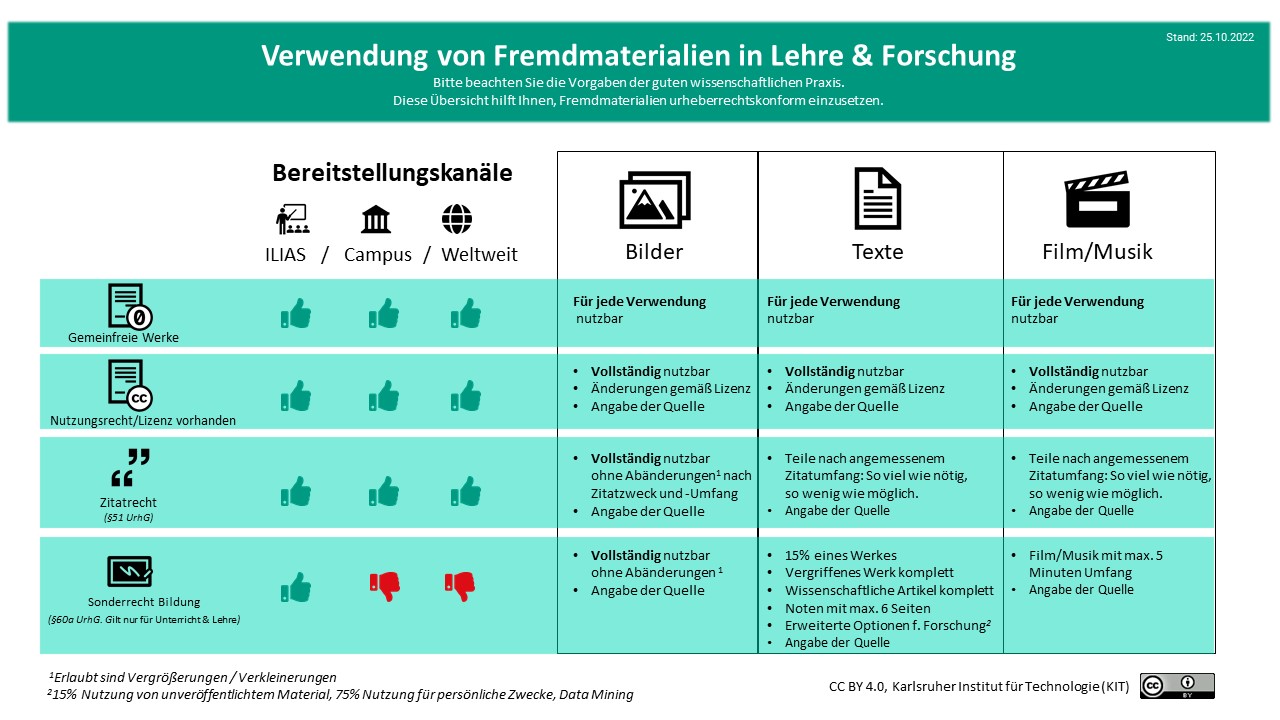
FAQ on OER
For practical guidance on implementing the OER policy, please see our FAQ:
Open Educational Resources (OER) can include any materials used in the context of teaching and learning (complete courses or programs, course materials, individual graphics, modules, student guides, instructions for teachers, textbooks, research papers, videos, interactive materials such as simulations and role-playing games, databases, software, applications, etc.). OER are always published under a free license (e.g., Creative Commons license).
a) Third-Party Rights
Publication may only take place if the works created are free of third-party rights and if the publication does not infringe upon any third-party copyrights or rights of use. If third-party materials (texts, images, graphics, etc.) were used in the creation of the works, it must be clarified in advance whether publication would infringe upon third-party rights. This would be the case, in particular, if the publication is not covered by a statutory license (example: quotation) or would violate contractual terms (licenses). If the publication would infringe on third-party rights, the ownership of such rights must be clearly established or clarified prior to publication, and, if necessary, licenses must be obtained from the rights holders.
b) Rights of KIT or third-party funding providers
In some cases, the rights may have been assigned even before the teaching materials were created. This would be the case, for example, if individuals create teaching materials as part of their official duties while employed at KIT. In such cases, the rights belong to KIT, and approval must be obtained from the respective department heads prior to publication.
In some third-party-funded projects, the funding agencies or the partners involved in the project also secure the rights to the project results. In such cases, the provision of teaching materials as OER must first be coordinated with the responsible supervisors in the organizational units. In case of doubt, DE Recht can be consulted for advice.
The creators/authors of the OERs are solely responsible for their content. When using OERs in one’s own teaching, the responsibility for quality control of the materials used lies with the respective instructor.
OER are also generally not entirely free of conditions for reuse. For example, even when reuse is otherwise permitted, the author(s) must often be credited (CC-BY license). In some cases, commercial reuse is also prohibited (CC-NC license). Employees and students must comply with the terms of use specified by the respective license.
Publication may only take place if the works created are free of third-party rights and, in particular, if the publication does not infringe upon any third-party copyrights or rights of use. If third-party materials protected by copyright (texts, images, graphics, etc.) are used in the creation of the works, publication is only permitted after the ownership of the rights has been clearly established and, if necessary, after obtaining permission.
In general, there are no mandatory requirements regarding the technical formats of OER. However, it is clear that certain formats are better suited for the reuse intended by OER than others. For example, PDFs are difficult to edit without appropriate, commercially purchased software. Therefore, it is recommended to use common file formats that also allow editing without commercial software. The OpenDocument formats (od*, etc.) are a good choice here, as they can be edited using open-source software. In general, care should be taken to avoid using specialized file formats that unnecessarily complicate editing with software other than the software used to create the file. With these considerations in mind, the following formats are suitable for OER: H.264, H.265 video, MPEG audio, WAV, GIF, JPEG, PNG, TIFF, HTML, plain text, Rich Text Format, XML, and CSV.
KIT recommends publishing written and interactive digital teaching materials in a suitable repository or on a publicly accessible website to maximize their visibility and use by others. The first point of contact for this at KIT is the central KITopen Repository (formerly DIVA). In addition, the KIT Library is working to establish procedures for forwarding content to the Central OER Repository (ZOERR) of the universities in the state of Baden-Württemberg.
When creating recordings and teaching materials for digital teaching, please observe copyright laws. These laws provide, via Section 60a of the German Copyright Act (UrhG), which provides expanded possibilities for the use of copyrighted materials for teaching and instruction.
Therefore, please consider in advance whether you want to use the recordings only for your students within the ILIAS learning management system, or whether you would like to publish them permanently (possibly even after the course has ended) and make them available to other users.