
One ID. A lifetime of impact.
With just a single ID, publications, data, and contributions are uniquely assigned and centrally recorded. This ensures that scientific work remains visible and measurable over the long term—at KIT and worldwide.
ORCID and KITopen support this effort by helping to increase the networking, visibility, and impact of research in a simple and sustainable way.

sprungmarken_marker_6598
Easily Link KITopen and ORCID
Link the two services in two steps:
- Log in to "Recording & Publication" on KITopen using your KIT account.
- In the “My KITopen” division, find the “ORCID and Your Profile” tile and follow the link.
Visibility in Research
ORCID and KITopen make research output visible, uniquely identifiable, and sustainable in terms of discoverability. Every publication, every dataset, and every contribution is centrally recorded and attributed to the correct individuals and to KIT.
For Researchers
-
Visibility of Individual and Diverse Biographies
-
Improved discoverability in systems worldwide
-
More efficient submission to publishers and grant applications
- Centralized management of research output
In short:
- Greater visibility
- More time for research
- Better career opportunities
For the Community
-
Increase opportunities for networking and collaboration
-
Creating role models (e.g., women and LGBTQIA+)
-
Promote inclusion and equal opportunity (DEI)
- Supporting transparent and open research (Open Science
In short:
- Stronger networking
- Greater transparency
- A more inclusive scientific culture
For Institutions
- Automatic assignment of researchers
- Integration into research information systems
- Efficient reporting and evaluation
- Improved data foundation and maintenance
In short:
- Higher data quality
- More efficient processes
- Greater visibility
Statement
"Thanks to KITopen and ORCID, my research findings are visible beyond the library's walls, which connects my library work to my scholarly practice."
Juliane Mörsel – ORCID member since 2023

KITopen Repository
KITopen is the central publication and repository system of the Karlsruhe Institute of Technology (KIT). It helps researchers publish their scientific work as open access, increase its visibility, and preserve it for the long term.
Features
- Open-access publication of scientific works
- Long-term, legally compliant archiving
- Structured collection and administration of metadata
- Assignment of DOIs for unique citability
- High visibility and discoverability worldwide
- Integration with ORCID and other identifiers
- Personalized advice and support
Research Profile ORCID
ORCID (Open Researcher and Contributor ID) is a unique, persistent identifier for researchers. It makes it possible to unambiguously attribute scholarly work to a specific individual and facilitates better networking within the research community. It is free to use and widely adopted internationally.
Benefits for Researchers
- Publications and activities are automatically linked and maintained
- Research achievements remain uniquely attributed even when name variations occur
- A wide range of scholarly activities becomes visible
- Research is centrally aggregated and discoverable worldwide
- Integration with publication systems such as KITopen
- Interested parties can quickly gain a complete overview of your profile
Statement
"ORCID makes the open-access publications and research data deposited in KITopen discoverable worldwide and connects KIT directly to global repositories, publishers, and funding agencies."
Wolfgang Süß – ORCID since 2021

Optimize Your Research Profiles Now
Get the most out of your KITopen profile by submitting publications, maintaining your bibliography, and keeping your metadata up to date.
-
Click “Check Media”
-
Check the list of media now displayed to see whether the items belong to your profile or not
-
Is this list complete?
In addition to publications, research data, presentations, and Open Educational Resources can also be recorded and published with a unique DOI (Digital
Object Identifier). Click “Record Media” and add additional media. -
Have the corresponding full-text files already been uploaded?
Use the “Upload” button to add full-text files.
Click on “My Media.” In the media list that appears, you can select individual entries and update them in “Edit Media” mode:
-
Content additions (keywords, abstract)
-
KIT-relevant information (POF structures, PSP elements, externally funded projects)
-
Custom labeling/sorting (KIT tags)
-
Relationships between media items (e.g., research data and publications)
-
For further information, please contact: kitopen∂bibliothek.kit.edu
-
Click “Create or link ORCID iD now” in KITopen
-
Your personal ORCID iD will now also be displayed in other KITopen services
-
Through extended permission transfer, KITopen will manage your ORCID profile
-
As soon as relevant publications for HGF reporting are available, a tailored list is displayed—associated full-text documents can be uploaded directly. KITopen offers a legally compliant service for this purpose.
Statement
"One ID. Global recognition.
My ORCID iD ensures that my scholarly output can be linked and uniquely identified worldwide. This makes my scholarly work visible and recognized internationally."
Mohamed Anis Koubaa – ORCID member since 2022
FAQs
Statement
"As a researcher, ORCID is an invaluable tool for me in ensuring that my work is correctly attributed and easily discoverable. By providing a unique, persistent identifier, ORCID allows me to seamlessly link my identity to my publications, grant proposals, and other scholarly contributions, which fosters transparency and trust in my academic profile."
Janis Fiedler – ORCID member since 2019

Publication Metrics and Reporting
KIT Library is happy to provide KIT members with individualized, subject-specific advice on the significance and responsible use of bibliometric analyses and databases, as well as on how to create and maintain an effective research profile.
Services:
- Use of bibliometric data sources and tools (e.g., Web of Science, Scopus, Google Scholar)
- Use and limitations of bibliometric indicators (e.g., H-index, Impact Factor) and alternative metrics
- Creating and maintaining research profiles (e.g., ORCID)
- Please feel free to schedule a personalized consultation.

Behind KITopen is a team that continuously develops the platform and validates scientific publications. We’re here to help you with any questions you may have about KITopen and using ORCID, maintain your publications, and make your research visible.

BUT you don't have to be so visible! Website with information and suggestions: “Be visible. Shape your own life.”
find out more
All the information you need about ORCID and the benefits of a permanent, unique identifier for researchers and authors.
find out more
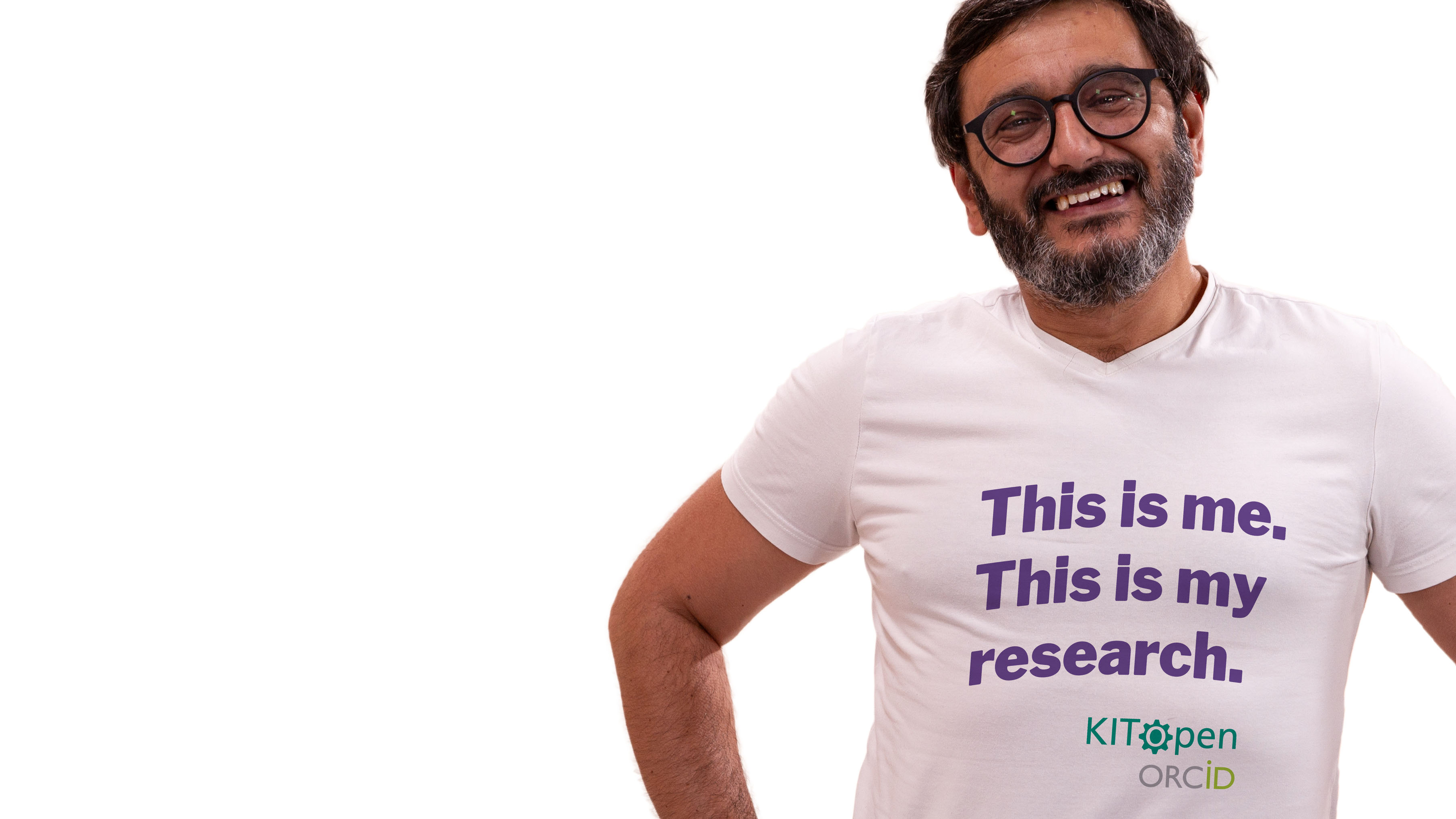
As part of the KITopen and ORCID campaign, themed “This is me. This is my research.” the campaign demonstrates how easy it is to link accounts and the added value this provides.
find out more
Since last winter term, in addition to direct uploads to KITopen, it has also been possible to quickly and easily import AV media from ILIAS/Opencast. KIT Library has now further improved the functionality of its Media Portal.
find out more
The DEAL Consortium, which negotiated the framework agreements with Wiley, Springer, and Elsevier, recommends—under the motto "OPEN ACCESS MEANS CC BY"—the use of the Creative Commons "CC BY" license whenever it is available.
find out more